 By Admin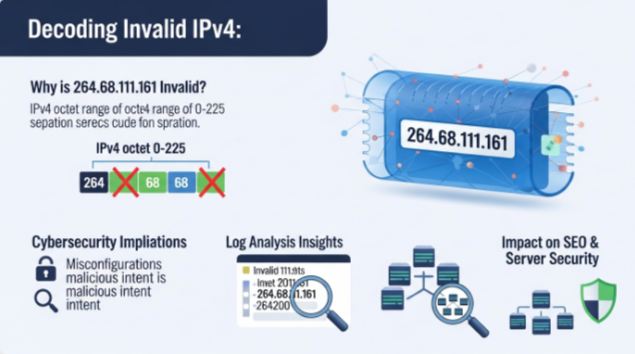
In today’s highly interconnected online world, IP addresses such as 264.68.111.161 tend to raise questions. Is it a legitimate server? A malicious IP address? A tracking point? Or perhaps a wrongly configured IP address? To ensure that website administrators, SEO experts, cybersecurity specialists, and regular online users remain informed and protected, it is essential to understand the basics of IP addresses and whether 264.68.111.161 is a valid IP address.
In this in-depth, SEO-friendly resource, we will cover everything you need to know about 264.68.111.161.
1. What Is 264.68.111.161?
264.68.111.161 looks like a normal IPv4 address at first sight. IPv4 addresses are normally expressed in dotted decimal notation, with four octets separated by dots.
But not all things that look like IP addresses are actually valid IP addresses.
The first thing to check when analyzing 264.68.111.161 is whether it follows the rules of IPv4 address representation.
2. Understanding IPv4 Address Structure
IPv4 (Internet Protocol version 4) is defined by the global standards body known as the Internet Engineering Task Force (IETF). It assigns numeric addresses to devices connected to the internet.
IPv4 Format Rules:
-
Four numbers separated by dots.
-
Each number (octet) must be between 0 and 255.
-
Total size: 32 bits.
-
Example: 192.168.0.1
Each octet represents 8 bits of data. Since 8 bits can only represent numbers from 0–255, anything above 255 is invalid.
Now let’s apply this rule to 264.68.111.161.
3. Is 264.68.111.161 a Valid IP Address?
The answer is no.
Why?
Because the first octet is 264, and IPv4 octets must be between 0 and 255.
Since 264 exceeds the maximum allowed value, 264.68.111.161 is not a valid IPv4 address.
This means:
-
It cannot be assigned to a server.
-
It cannot exist in real-world networking.
-
It cannot route traffic on the public internet.
-
It cannot belong to a hosting provider.
From a technical standpoint, 264.68.111.161 is mathematically invalid within IPv4 addressing rules.
4. Why Does 264.68.111.161 Appear in Logs?
If the IP is invalid, why might it show up in:
-
Website analytics?
-
Server logs?
-
Firewall reports?
-
Suspicious traffic monitors?
There are several possible explanations.
1. Typographical Errors
Humans sometimes mistype IP addresses. For example:
-
164.68.111.161 (valid)
-
264 instead of 164 (mistyped)
2. Malformed Requests
Hackers or bots sometimes inject malformed IP addresses into headers to:
-
Confuse logging systems
-
Exploit poorly coded applications
-
Test input validation
3. Log Corruption
If server logs are damaged or incorrectly parsed, numeric overflow may occur.
4. Spoofed Headers
Attackers sometimes modify:
-
X-Forwarded-For headers
-
Client-IP headers
If the system does not validate values correctly, invalid addresses like 264.68.111.161 may appear.
5. Cybersecurity Implications of Suspicious IP Entries
Even though 264.68.111.161 is invalid, its presence may signal:
-
Bot activity
-
Penetration testing attempts
-
Injection attacks
-
Log manipulation attempts
Cybersecurity organizations like OWASP emphasize strict input validation to prevent exploitation.
Potential Security Risks:
-
SQL Injection attempts
-
Header spoofing
-
Log poisoning
-
Application-layer attacks
If your system accepts 264.68.111.161 as valid input, that indicates a validation flaw.
6. SEO Implications of IP Reputation
Search engines like Google evaluate website trustworthiness based partly on:
-
Server integrity
-
Hosting IP reputation
-
Malware history
-
Spam signals
While 264.68.111.161 cannot affect SEO directly (since it’s invalid), seeing malformed IP traffic can signal:
-
Bot scraping
-
Spam attempts
-
Negative SEO attacks
If your server is receiving unusual traffic patterns, it’s worth investigating.
7. How to Investigate an IP Address Properly
When analyzing an IP address, follow this structured approach:
Step 1: Validate Format
Ensure:
-
Each octet is between 0–255.
-
No extra characters.
-
Correct dotted decimal format.
Since 264.68.111.161 fails at step one, investigation stops here.
Step 2: Use WHOIS Lookup
Valid IPs can be checked via:
-
ARIN
-
RIPE
-
APNIC
These regional registries allocate IP blocks globally.
Step 3: Reverse DNS Lookup
Helps determine:
-
Hosting provider
-
Associated domain
-
Server type
Step 4: Threat Intelligence Check
Use tools like:
-
VirusTotal
-
AbuseIPDB
-
SecurityTrails
But remember — 264.68.111.161 will not return results because it’s invalid.
8. Server Logs and 264.68.111.161
If you discover 264.68.111.161 in logs:
Check Your Web Server
Common servers:
-
Apache HTTP Server
-
Nginx
-
Microsoft IIS
Verify whether:
-
IP validation is enabled.
-
Proxy headers are trusted.
-
Load balancer forwarding is configured correctly.
Example Log Entry
If you see this, your application likely logged header data without validating the IP.
9. How to Block Suspicious IP Traffic
Even invalid IP attempts suggest malicious behavior.
Implement:
-
Firewall rules
-
Web Application Firewall (WAF)
-
Rate limiting
-
Strict header validation
Popular WAF Providers:
-
Cloudflare
-
Akamai Technologies
These services filter malformed requests before they hit your server.
10. IPv4 vs IPv6 Comparison
Some confusion arises between IPv4 and IPv6.
IPv6 addresses look like:
Managed globally by the Internet Corporation for Assigned Names and Numbers (ICANN).
264.68.111.161 is not an IPv6 address either.
11. Programming Validation Example
Developers should validate IP input using:
-
Regex patterns
-
Built-in language validators
-
Strict numerical boundary checks
In most programming languages, validating 264.68.111.161 would return false.
Proper validation prevents:
-
Log injection
-
Header spoofing
-
Application crashes
12. Could 264.68.111.161 Ever Exist?
Short answer: No.
Unless IPv4 rules change (which is unlikely due to backward compatibility), 264.68.111.161 cannot become valid.
The maximum IPv4 range is:
255.255.255.255
Anything beyond that is outside the addressable internet space.
13. SEO Strategy Around IP-Based Searches
Interestingly, people search IP addresses for:
-
Server identification
-
Hacking curiosity
-
Suspicious traffic
-
Hosting lookup
Creating educational content about IP validation (like this guide on 264.68.111.161) can:
-
Capture technical search intent
-
Rank for numeric keyword queries
-
Provide cybersecurity authority signals
14. Common Misconceptions About 264.68.111.161
Myth 1: It’s a Hidden Server
False — invalid format.
Myth 2: It’s a Government IP
False — impossible.
Myth 3: It’s a Virus
Not directly — but malformed traffic can indicate malicious activity.
15. Best Practices for Handling Suspicious IP Addresses
-
Validate all input.
-
Sanitize headers.
-
Monitor log anomalies.
-
Use reputable hosting.
-
Enable firewall protection.
-
Keep software updated.
-
Monitor unusual patterns.
Final Verdict on 264.68.111.161
After technical analysis:
-
264.68.111.161 is NOT a valid IPv4 address.
-
It cannot exist on the public internet.
-
Its presence in logs likely indicates malformed or malicious input.
-
Proper validation and firewall protection prevent exploitation.
Understanding IP structure is critical for:
-
Cybersecurity
-
SEO trust
-
Server integrity
-
Network administration
Even though 264.68.111.161 may look like a real IP address, it fails fundamental IPv4 rules.
Conclusion about 264.68.111.161
In a world where cybersecurity threats are always changing, even something as basic as 264.68.111.161 can offer a valuable reminder: validation is important.
No matter if you are a website owner, developer, SEO expert, or security professional, understanding how IP addresses function is an important way to protect your online assets.
The next time you notice 264.68.111.161 in your logs, remember this:
It’s not a “real” IP address, but it might mean something real is going on in the background.